111 terms for effective leadership
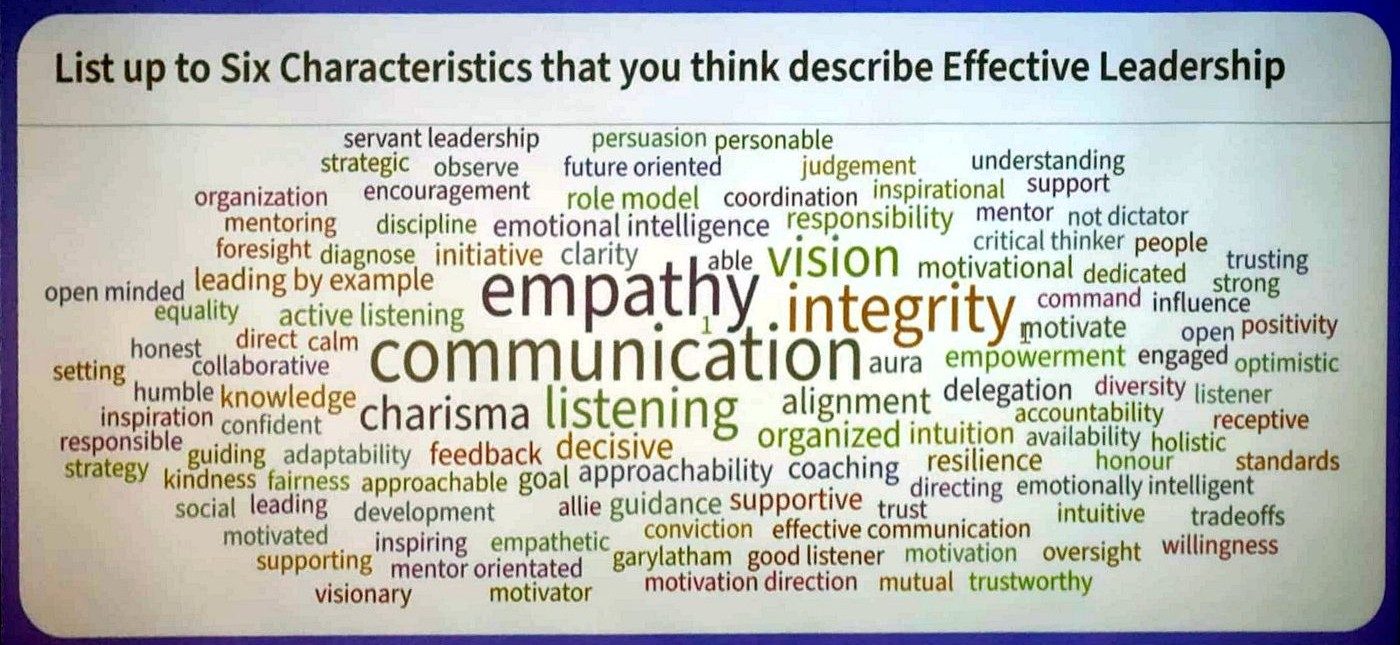
The class was asked to list up to six characteristics that describe effective leadership. These are all the distinct terms that came back. Each card compares those terms with the five basic conditions of teamwork from the Session 1 required reading.
Even the best leader on the planet can't make a team do well. All anyone can do is increase the likelihood that a team will be great by putting into place five conditions.Coutu (2009), interviewing J. Richard Hackman · reference 1
All 111 terms
One bar per term, ordered by the size it rendered at on the poll slide and alphabetically within each size. Bar length is that size, indexed so the largest is 100. Hover any term for the condition it maps to and the reasoning behind that.
Limitations. The photograph was taken at an angle, so the slide rendered as a trapezoid. Fitting the four edges puts the right side nearer the camera, with its edge 1268 pixels against 1078 on the left, a magnification of 1.18 across the slide. That is smaller than the narrowest gap between one size tier and the next, which is 1.39, so the distortion cannot move a word across a tier boundary. The image above has been corrected for it.
How to read the 89
Hackman treats personal qualities as necessary. He credits emotional maturity as what lets a leader set a direction at all, and the five conditions are themselves things leaders "must fulfill". The answers are incomplete: 89 of them name a quality of the leader and none of the five conditions.
"Don't try to ape any leadership model or team, because there's no one right style for leading a team."
References
- 1. Coutu, D. (2009). Why teams don't work: An interview with J. Richard Hackman. Harvard Business Review, 87(5), 99–105. Session 1 required reading. The five basic conditions and the deviant quotation are from the sidebar "How to Build a Team".
- 2. Hackman, J. R. (2002). Leading teams: Setting the stage for great performances. Boston, MA: Harvard Business School Press. The book the five conditions in reference 1 are drawn from.
- 3. Leonardelli, G. (2026). RSM 2620 Leading Teams course syllabus, 2026–2027 Fall Intensive. Rotman School of Management, University of Toronto.course document Source of the requirement to evaluate teams against the five basic conditions, and of the observe-diagnose-do model.
- 4. Leonardelli, G. (2026). List up to six characteristics that you think describe effective leadership [Poll Everywhere response cloud]. RSM 2620 Leading Teams, Sessions 1 and 2, 29 August 2026. PollEv.com/geoleoprofessor's slide Primary data, and the professor's own live poll slide. Every figure on this site is counted from the response cloud projected in class at 4:02pm.